


Audible, the Internet’s leading provider of spoken audio entertainment, has more than 150,000 downloadable titles across all types of literature, including fiction, nonfiction, and periodicals. For a free trial and free audiobook to keep, visit this link.
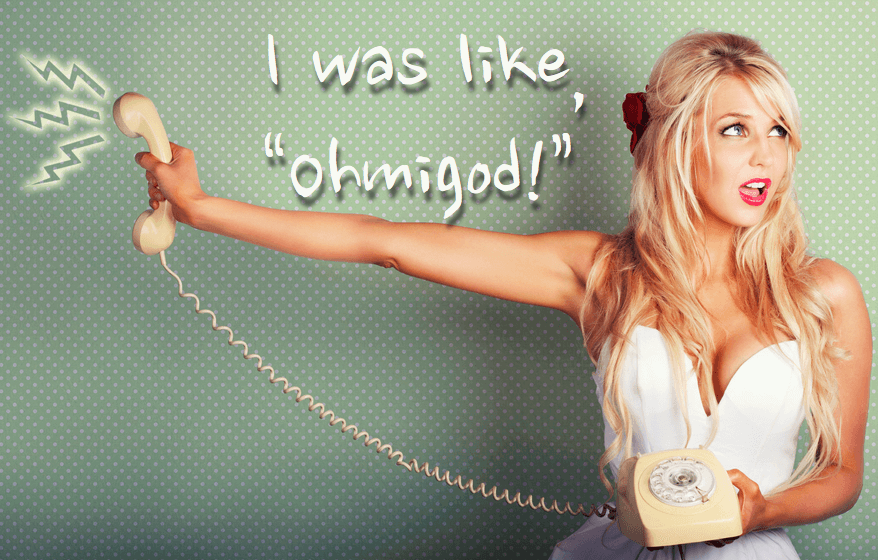
Like, I’ve been doing this podcast for, like, eight years now, but there’s, like, one language peeve that I’ve never thought to write about, so when a listener asked me about it, I was, like, “I can’t believe we’ve never covered this before!”
Not All Likes are Alike
As you’ve probably guessed by now, the complaint is about the overuse of the word like. However, before we can talk about that, we need to draw a few distinctions, because not all likes are alike. For example, if I were to say, “I don’t like this hat; it makes me look like a mushroom,” even the most conservative speakers would have no problem with like as a verb in I don’t like this hat, or like as an adjective in look like a mushroom.
The verb like and the adjective like are separate words. They have different meanings and are used in different places in a sentence. And although they’re homonyms these days, they even used to sound different. According to the Oxford English Dictionary, the verb like comes from the Old English lician (“lick-ee-on”), while the adjective like comes from the Old English l?ch (“leekh,” where “kh” is the sound you get when you try to make a K, but don’t let your tongue quite touch the roof of your mouth. To an English-only speaker, it will sound like a labored H sound.)
The newer uses of like have different meanings, too, and one linguist argues that they’re actually four separate words, in the same way that like the verb and like the adjective are separate words.
Alexandra D’Arcy of the University of Victoria in British Columbia wrote her dissertation on what she calls the vernacular functions of like, and has published a number of papers on them. Here, I’ll summarize some of her points from a 2007 article in American Speech.
The Quotative Like
The first function D’Arcy lists is sometimes called “quotative like,” and it always occurs with a form of the verb be. I said it in my example sentence when I said, “I was like, ‘I can’t believe we’ve never covered this before!’”
Quotative Like Can Mean Something Different From Think or Said
A lot has been written about quotative like since it was first noted in the journal American Speech in 1982. Quotative like has a more general meaning than the verbs say or think, because it can cover both saying and thinking. If you say, Squiggly was like, “I’m outta here,” that doesn’t necessarily mean Squiggly said it; it could mean that his behavior suggested that he wanted to leave. Furthermore, quotative like even has the power to incorporate non-linguistic gestures into the grammar of a sentence. Listen; I’ll do it now: I was like [shrug]. It works better if you can see me. Right after I said, “I was like,” I shrugged.
Quotative Like Is Relatively New
Often, when some new word or usage becomes widespread enough to be noticed, there’s a perception that it only started recently, but when linguists or lexicographers investigate, it usually turns out to be much older than people thought. However, quotative like is an exception. As D’Arcy found in her study, it really does seem to have begun in the 1980s. She found that speakers who would have been teenagers in the 1980s used quotative like significantly more than older speakers, who hardly used it at all.
Furthermore, it caught on much faster than the other vernacular uses of like, so that the teenagers of the 1990s and later use quotative like in about half the situations where they could use it or say or think.
Valley Girls Really Did Coin the Quotative Like
Another popular perception about quotative like is that it originated with the stereotyped, “Ohmuhgod!” persona of the California Valley Girl of the 1980s. Typically, when linguists investigate neat and tidy origins like this, they turn out to be false, but once again, quotative like is the exception. D’Arcy’s research indicates that they may indeed have been the source of quotative like, and in any case, it’s certainly an Americanism.
The Approximate Adverb Like
However, Valley Girls weren’t the source of the other three vernacular uses of like, which have longer histories, and occur in dialects of English around the world. The second one that D’Arcy discusses is what she calls the approximative adverb like. I used it when I said, “I’ve been doing this podcast for, like, eight years now.” The like here modifies eight years, and has pretty much the same function as the word about or the phrase more or less. She finds that this use of like was rare 75 years ago, but has increased a lot since then, and in the early 1970s, it passed about, which is on its way down.
Like as a Discourse Marker
The third vernacular use of like in D’Arcy’s analysis is as a discourse marker—in other words, at the beginning of a sentence, where a word such as well or so might go. Like is used as a discourse marker in Like, I’ve been doing this podcast for eight years, and this sentence also sounds natural if I replace like with well: Well, I’ve been doing this podcast for eight years.
This use of like was already well-associated with the Beat-generation writers and musicians of the 1940s and 1950s, but D’Arcy also found examples of it from speakers in the United Kingdom who would have been using it early in the 20th century. But although like as a discourse marker isn’t as recent as you might have thought, D’Arcy still finds that it has been steadily increasing for the last 60 years or so.
Like as a Discourse Particle
The final use of like in D’Arcy’s classification is as a discourse particle. I used like this way when I said, “there’s, like, one language peeve that I’ve never thought to write about.” I put it right before the noun phrase one language peeve, but it can also go before verb phrases, adjective phrases, and other kinds of phrases, although D’Arcy only focused on these three kinds. She finds that like as a discourse particle has also been steadily increasing in use for the last 60 years, just as discourse-marker like has been doing.
Now personally, I didn’t see much difference between like at the beginning of a sentence, which D’Arcy calls a discourse marker, and like before smaller phrases, which she calls a discourse particle. Furthermore, the fact that they’ve both been increasing in usage at about the same rate suggests to me that they’re the same word. However, there are some differences. For one, you can’t easily replace the discourse particle like with a word like well. In my sample sentence, it would sound like this: there’s well one language peeve that I’ve never thought to write about. You could kind of make it work if you used just the right intonation, but it’s nowhere near as natural-sounding as Well, I’ve been doing this podcast for eight years.
D’Arcy also shows another way that discourse-marker like is different from discourse-particle like: women are more likely than men to use like as a discourse marker, whereas men are more likely than women to use like as a discourse particle.
Do Women Use Like More Than Men?
This brings us to another popular perception that D’Arcy challenges: That women use like much more than men. Her finding is that the answer depends on which vernacular like you’re talking about. For discourse-marker like, yes. For discourse-particle like, no. For like as an approximating adverb, men and women are equally likely to use it. And for quotative like, women are more likely than men to use it—at least in the speaker population that D’Arcy sampled.
So some of the popular perceptions about vernacular like are false, but some are true. Specifically, quotative like is as recent as people thought it was, and it may well have originated with Valley Girls. Furthermore, D’Arcy speculates that the Valley Girl stereotype may have increased the usage not only of quotative like, but also of the other vernacular uses, because of ordinary speakers’ failure to notice the differences between the different functions.
In any case, all this doesn’t mean these various uses of like are good, or bad. In speech, occasionally using these versions of like can be a good thing. Studies have shown that speech that sounds too careful, without any stumbles, pauses, or conversation fillers such as like, um, and you know, can sound awkward, dogmatic, and unfriendly. On the other hand, of course you shouldn’t overdo it, using like in every sentence as I did in the opening of this section. Furthermore, all these uses of like are still considered informal, so if you’re writing or speaking in a formal register, don’t use them.
Sources
D’Arcy, Alexandra. 2007. “Like and language ideology: Disentangling fact from fiction.” American Speech. Volume 82, Number 4: 386-419 doi: 10.1215/00031283-2007-025 Click This link
Image courtesy of Shutterstock.
This article was written by Neal Whitman, who has a PhD in linguistics and blogs at Click this link.