
Writing Accents and Dialects

How to add character without offending.

Today’s topic is how hit the right tone when you give characters accents and dialects.
To flavor a novel and provide authenticity, authors often use dialect in their written dialogue. But the use of dialect in writing is tricky, and if you don’t use care and sensitivity, it may backfire. It may say more about the author and his or her assumptions than about the characters, or it may distract readers to the point that what is being said is overshadowed by how it’s being said.
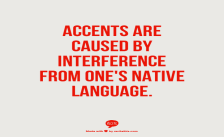
First, let’s talk about the difference between accent and dialect. When we talk about a person’s accent, we’re referring to how they pronounce words. So when Eliza Doolittle sings, “Just you wait, ‘enry ‘iggins! Just you wait!” she is using standard English with a Cockney accent. Accents are caused by interference from one’s native language, as with Arnold Schwarzenegger, who speaks with an Austrian accent, or by interference from one’s native dialect, as with Holly Hunter, who speaks with a Georgian accent. Both speak accented standard American English.
Accents In Writing
When writing for a character with an accent, it is tempting to render the character’s speech phonetically using nonstandard spellings. However, this practice is risky and should be avoided, unless you specifically want to emphasize how a character speaks. First, there’s the question of how accurate to be. The more accurate the phonetic spelling, the more frustrating it will be to read. Most adults read word by word, not sounding words out letter by letter, so forcing adults to sound out nonstandard phonetic spellings would slow readers down, potentially irritating them, and thus distract them from the actual story. Second, if you decide to render one character’s speech phonetically, what about that of the others? In Gone With The Wind, Margaret Mitchell uses nonstandard spellings for the speech of blacks while using standard spelling for whites even though the speech of both groups is phonetically very similar. Earl Conrad argues that Mitchell is typical of white Southern writers of her day who employed dialect to reinforce the erroneous belief that blacks are inferior–that their speech is so bad it can’t even be spelled properly.(1) Finally, don’t use nonstandard spellings for common pronunciations, such as gonna, g-o-n-n-a, and gotcha, g-o-t-c-h-a. These pronunciations are present in all dialect of English, so there’s no need to distract the reader by drawing attention to them.
The other option for communicating a character’s accent to readers, which I recommend, is to use standard spelling along with a description of the character’s speech in the text introducing the character. One might write, “Her roots in the South were evident in her slow, melodious speech,” while using standard spelling when writing out her speech. This method is much easier for the reader and avoids inadvertently stigmatizing a character.
Dialects In Writing
Dialect is about what words are used, how they’re pronounced, and how sentences are put together. For example, use of the word pop to mean a carbonated drink is characteristic of the Midwest dialect, the fact that cot and caught are pronounced the same is characteristic of Utah speech, and use of the construction might could in sentences like We might could meet for lunch next week is a feature in the South. Standard American English is itself just another dialect.
Nonstandard Grammar
When writing for a character who speaks a nonstandard dialect, in addition to dealing with the spelling question, you have to be sure to get the grammar right. The phrase nonstandard grammar may sound like an oxymoron, but nonstandard varieties of English are also governed by rules. After all, for communication to happen, there must be collectively agreed upon rules underlying all language.
The majority of grammar rules for someone’s native dialect, whether standard English or a nonstandard variety, aren’t taught in school; instead, they are formulated unconsciously at a very early age based on patterns in the surrounding speech.* Even before children start school, they are able to form complete sentences; they use suffixes to make nouns plural and to make verbs past tense; they invert word order to form questions; and they negate sentences with no and not. And, while we might not be consciously aware of all of these rules and can’t explain why a sentence “sounds wrong,” we still recognize a grammatical error.†
Authentic Dialect
The same is true for speakers of nonstandard dialect. If an author writes dialect dialogue that violates the internal rules, at best the character will sound inauthentic, at worst the writer will be criticized for stereotyping or presenting a caricature. For example, speakers of African American English add the word be before a verb to indicate that the action is habitual or ongoing. The sentence He be sleeping on the couch means ‘he sleeps on the couch on a regular basis’, while He sleeping on the couch means ‘he’s sleeping on the couch now.’ People trying to imitate African American English in speech and writing often overuse this grammatical form, which linguists call “habitual be.” Instead, they insert it in front of verbs throughout without realizing their mistake.
To sum up, if you’re going to write in dialect, make sure you know the rules of that dialect so you don’t insult your readers and be conscious of how nonstandard spelling and dialect might influence your readers’ opinions of your characters and of you as the writer.
Also, thanks again to Charles Carson, managing editor of the journal American Speech, for writing today’s episode.
Contact
Finally if you have questions, please post them on the Grammar Girl pages Facebook page.
And while you’re here on the QDT website, please check out our other experts if you haven’t already.
Notes
- *Infants, even before they have the ability to speak themselves, recognize the patterns in the speech around them. Studies have shown that infants will respond negatively to speech that deviates from the rules they have internalized from the patterns they’ve experienced. It is these rules that they eventually use to generate their own speech, and as they begin to speak, these rules are further refined through trial and error. These rules are mostly unconscious, and it is these rules we continue to use into adulthood to form the majority of our speech.
†If we all start school already equipped with the majority of grammar rules, what are we learning there? First, we learn how to talk about language; we learn the name and function of nouns, verbs, adjectives, etc., and how they go together. Second, we learn rules that resolve grammatical issues that are in transition. For example, for better or worse, the use of whom is disappearing. Therefore, it isn’t possible for children to pick up on the patterns of who and whom because they aren’t sufficiently exposed to their usage. So the who vs. whom rule must be taught. Finally, we learn the rules for formal and written speech that differ from the rules we’ve picked up from everyday speech. Many things are permissible in everyday speech that are not permissible in writing.
References
- Conrad, E. “The Philology of Negro Dialect.” Journal of Negro Education, Vol. 13, No. 2, Spring 1944, pp. 150–54.
- Carkeet, D. “The Dialects in Huckleberry Finn.” American Literature, Vol. 51, No. 3, Nov. 1979, pp. 315–32.
- Sewell, D. “Dialect.” In The Mark Twain Encyclopedia, ed. J. R. LeMaster and J. Wilson, 219–20. New York: G
arland, 1993.