
The job of managing personal finances can be so overwhelming that it can feel like a full-time job. Try to keep track of the monthly subscriptions that you pay for, manage the household budget, and try to pay off the various debts that you owe. All the while trying to put some money aside for long-term goals. Most people find that sitting at a kitchen table with a cold cup of coffee and 3 different banking apps open on their phone leads to a brick wall of procrastination. We all know that money management can be complicated, but that doesn’t mean that we can’t simplify our money routine and manage our finances in a way that leaves us with more energy to do all of the things that we enjoy.
Simplifying your finances doesn’t have to be about cutting out every little expense from your life and following a strict set of rules. Rather, creating a simple system for managing your money can help you keep track of your financial life without being a huge burden on your mind. So how do you create a simple system for managing your finances that you can actually stick to? Here are 5 ways to help you simplify your money routine.
1. Automate Your Savings and Bill Payments
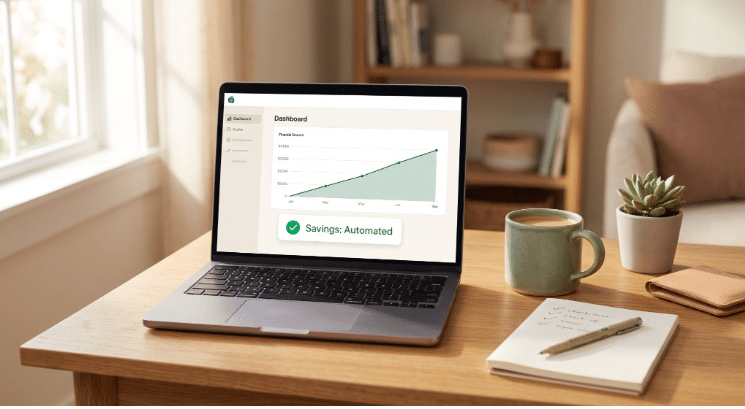
By removing ourselves from the equation and allowing funds to move automatically, we can greatly reduce financial stress. Most essential bills are paid on a recurring basis. By setting these up to be paid automatically, we can avoid late charges and have a lot less stress as a result.
Automating your savings goals is a good practice too. Set up automatic transfers to your savings account as soon as your paycheck lands, so you’re meeting your savings goals before you have a chance to spend the money.
Pay yourself first.
Treat that transfer as a non-negotiable expense, the same as any other recurring bill. Automating it means you won’t have to rely on remembering or on willpower to make it happen each month.
AI-driven financial planning can take this a step further, analyzing your spending across connected accounts and surfacing personalized insights to help guide your budget and keep you moving toward your goals. This gives you a clearer picture of your financial situation without spending hours poring over a spreadsheet.
How much time do you actually spend crunching numbers?
2. Consolidate Your Bank Accounts
Over time, the accounts we opened in the past just sit there. Checking accounts, old savings accounts, even credit cards with the rewards of old, no longer applicable to our current spending habits. Try to manage your money with all these accounts, and you’ll be lost, unable to properly keep track of your overall net worth. Try simplifying your financial life by condensing your various bank accounts to the basics.
For example, having multiple old savings accounts or checking accounts can really be a pain to manage. So consider consolidating your accounts. Have one main checking account for all of your bills and daily spending and a high-yield savings account for your short-term goals. Also, if you have multiple credit cards, consider which ones offer enough value for the categories that you spend a lot in and then cut up the rest. It’s nice to have fewer accounts to keep track of, and it really makes your monthly money review so much easier. Less screen time and fewer account login details to remember is less stress.
3. Create a Simple Bucketing System
Rather than the time and effort it takes to set up a traditional line-by-line budget and account for every last cup of coffee or trip to the grocery store, a “bucketing” system offers a simpler alternative. In “bucketing,” you organize your income into a few big categories rather than making a detailed list of how you spend your money.
There’s an easy way to divvy up your take-home pay into three buckets and stick to your budget: the 50/30/20 rule.
- Fixed Expenses: Rent, utilities, insurance, minimum debt payments, and groceries.
- Goals: Emergency fund savings, retirement contributions, and investments.
- Flexible Spending: Dining out, hobbies, shopping, and entertainment.
This will leave you with the amount you can use in your flexible spending account each month without having to monitor every purchase. You will still be aware of your total Flexible Spending and know how much money is available for you to use in your spending each month.
Why should managing your money have to be like following a strict diet and constantly keeping track of every single detail? There’s a better way of looking at managing your finances.
4. Conduct a Monthly Financial Reset
The best way to manage your money is to spend time on it less frequently, not more. You could either check your account online several times a day, worrying about each purchase, or more sensibly, dedicate thirty minutes once a month to reviewing your finances. Clear the clutter from your desk, switch your phone to silent, and get settled.
Set a timer for thirty minutes. This time can be reserved to sort out your finances.
During this time, you will review the following:
- Statements: Review your bank and credit card statements from the past month to identify hidden surprises and troves of unused subscriptions. If you keep a money tracker, this is the moment to match its entries against your actual statements so the numbers stay accurate.
- Goal progress: Check progress on your short-term and long-term financial goals.
- Flexible spending: Revisit your flexible spending periodically to account for vacations, holidays, and similar cash needs in the months to come.
This routine can be set up to ensure that you do not have to constantly be thinking about and monitoring your finances throughout the day. It helps to keep your financial life organized and on track.
5. Clean Up Recurring Subscriptions and Digital Clutter
Charges from your digital subscriptions, along with the costs of a constant stream of deliveries to your home, can quietly drain your bank account each month. Because these recurring individual costs are typically pretty small, it’s easy for their true total to stay hidden until you see them add up on your bank statement.
Is there more than one streaming platform you pay for that you have actually used in the past month?
Set aside some time to look through your bank statements. First, identify all of your recurring expenses, and then sort them into categories of how often you actually use them. Consider canceling subscriptions you haven’t used in the past 30 days. Also consider canceling memberships and recurring deliveries of things you no longer need. Additionally, cancel your promotional emails from retailers to prevent frequent impulse buys.
Of course, simplifying your money routine does not have to mean neglecting your finances. You can very well automate, unclutter your accounts, and focus on your higher goals for your money. It just needs to work for you and not against you. So go ahead and take control of your finances. You can do it with far less stress on a daily basis.