



Affect Versus Effect

Quick and Dirty Tips
  • Podcasts
    • Grammar Girl
    • Curious State
    • Get-Fit Guy
    • Money Girl
    • Project Parenthood
    • Relationship Doctor
    • Modern Mentor
    • Nutrition Diva
    • Savvy Psychologist
    • Who Knew?
    • Unknown History
    • Modern Manners Guy
  • Books
  • Categories
    • Health & Fitness
    • House & Home
    • Parenting
    • Relationships
    • Pets
    • Education
    • Tech
    • Productivity
    • Business & Career
    • Money & Finance
  • Offers
  • About QDT

What's Hot

How Many Retirement Accounts Can You Have?

September 8, 2023

Grandma Knows Best: Your Top Dating Tips

September 7, 2023

When Is It OK to Write ‘Loosely’?

September 6, 2023
opens in a new window Facebook opens in a new window Twitter opens in a new window Instagram
Quick and Dirty Tips
  • Podcasts
    • Grammar Girl
    • Curious State
    • Get-Fit Guy
    • Money Girl
    • Project Parenthood
    • Relationship Doctor
    • Modern Mentor
    • Nutrition Diva
    • Savvy Psychologist
    • Who Knew?
    • Unknown History
    • Modern Manners Guy
  • Books
  • Categories
    • Health & Fitness
    • House & Home
    • Parenting
    • Relationships
    • Pets
    • Education
    • Tech
    • Productivity
    • Business & Career
    • Money & Finance
  • Offers
  • About QDT
opens in a new window Facebook opens in a new window Twitter opens in a new window Instagram opens in a new window Pinterest
Quick and Dirty Tips
You are at:Home » Affect Versus Effect
Grammar Girl

Affect Versus Effect

When should you use "affect" vs. "effect"? We have an example, a memory trick, and a cartoon to help you remember when to use "affect" or "effect."

By Mignon FogartyJuly 7, 2016No Comments8 Mins Read
opens in a new window Facebook opens in a new window Twitter opens in a new window Pinterest opens in a new window LinkedIn opens in a new window Tumblr opens in a new window Email
opens in a new window Apple Podcast Page opens in a new window Spotify Podcast Page opens in a new window Google Podcast Page opens in a new window Amazon Play Podcast Page
opens IMAGE file
Share
opens in a new window Facebook opens in a new window Twitter opens in a new window Pinterest opens in a new window WhatsApp opens in a new window Email

I get asked whether to use affect or effect all the time, and it is by far the most requested grammar topic, so I have a few memory tricks to help you remember. Before we get to the memory trick though, I want to explain the difference between the two words.

What Is the Difference Between ‘Affect’ and ‘Effect’?

The majority of the time you use affect as a verb and effect as a opens in a new windownoun. Affect can either mean “to influence” or “to act in a way that you don’t feel.” Effect typically means “a result.”

‘Affect’ and ‘Effect’ Are Pronounced Differently

The words sound the same to a lot of people, but there is actually a small difference in how they are pronounced.

Effect is pronounced [ih-fekt], almost like it has an I-sound at the beginning.

The main way affect is pronounced is [uh-fekt], more like it has an A-sound at the beginning.

When Should You Use ‘Affect’?

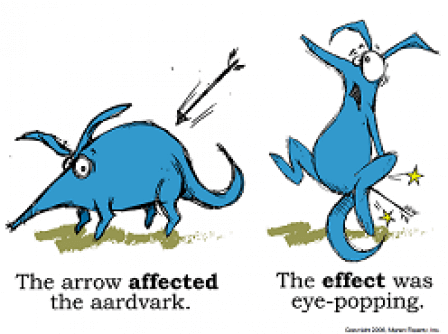
Affect with an a means “to influence,” as in, The arrows affected Aardvark, or The rain affected Amy’s hairdo. Affect can also mean, roughly, “to act in a way that you don’t feel,” as in, She affected an air of superiority.

When Should You Use”Effect’?

Effect has a lot of subtle meanings as a noun, but to me the meaning “a result” seems to be at the core of all the definitions. For example, you can say, “The effect was eye-popping,” or “The sound effects were amazing,” or “The rain had no effect on Amy’s hairdo.”

‘Affect’ vs. ‘Effect’ Example Sentences

Here are more examples of the common uses of affect and effect:

Effect as a noun

Squiggly marveled at the effect fishing had on Aardvark’s mood.

Aardvark wondered whether the heat was having an effect on the fish.

Affect as a verb

Squiggly wished that beans didn’t affect his stomach so much.

Aardvark’s grumpiness affected everyone else’s mood last night.

‘Affect’ vs. ‘Effect’: Common Uses

Most of the time, affect is a verb and effect is a noun.

There are rare instances where the roles are switched, and I’ll get to those later, but for now let’s focus on the common meanings. This is “Quick and Dirty” grammar, and my impression from your questions is that most people have trouble remembering the basic rules of when to use these words, so if you stick with those, you’ll be right about 95% of the time.

Most of the time, affect is a verb, and effect is a noun; and now we can get to the memory tricks and more examples,

‘Affect’ vs. ‘Effect’: The RAVEN Trick 

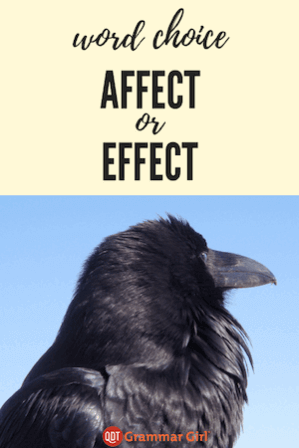
I remember how to use affect and effect by thinking of a big black raven. A raven? Yes, a raven! Because raven has the letters A-V-E-N in it, and those also stand for

Affect: Verb              Effect: Noun

Fix that image of a raven in your mind, and you’ll always remember the most common way to use these words. I actually remember the sentence The craven raven flew down the avenue, because craven, raven, and avenue all have the A-V-E-N sequence, and in my mind, the evil raven is flying down the avenue of a German town with those timbered white Bavarian-style houses. I don’t know why. I have a wild imagination. Find yours, and really imagine that affect-verb-effect-noun raven so you’ll always remember it.
WORD CHOICE: affect or effect?

Once people remember the RAVEN trick, they often ask for tips to figure out whether the word they’re trying to use is a noun or a verb. Do I have some? Of course, I do!

Verbs Are Actions, and ‘Action’ Starts with A

Verbs are often actions, and the word action starts with the letter A, just like the verb affect. If the word you want describes an action, then you want the word that starts with an A—affect.

See if you can substitute another verb for the word you want. Here’s an example. If your sentence is The arrows affected Aardvark, you can tell that affected is a verb first because it can become past tense by adding -ed (nouns don’t do that), and second because you can substitute other verbs such as hurt, poked, and hit:

The arrows affected Aardvark.

The arrows hurt Aardvark.

The arrows poked Aardvark.

The arrows hit Aardvark.

Alternatives to ‘Affect,’ the Verb

The verb affect is vague, and when people don’t know whether to use affect or effect, sometimes they use opens in a new windowimpact instead, which besides having problems of its own, is also vague. When you’re thinking about using either of those words, see if you can use a better verb, a more specific verb, instead.

Here’s an example: Maybe you’re trying to write something like

The weather affected Aardvark’s holiday plans.

What does affected really mean in that sentence? It’s better to be more specific, and write something like

The weather ruined Aardvark’s holiday plans.

Now you know what really happened, not just that the plans were affected, somehow changed, but they were changed in a bad way—they were ruined.

Now let’s move on effect, the noun.

Nouns Can Take an Article Such as ‘The’
affect effect aardvark

Remember how we knew that affect was a verb because we could make it past tense with the -ed ending, and that’s something we can’t do to nouns? Well, nouns also have their own special feature: You can put a grammatical article, such as the, in front of a noun, and you can’t put one in front of a verb.

Here’s an example:

The effect was eye-popping.

Notice that I said “the effect.” The word has an article before it, so it’s a noun. You can remember that by noting that the word the ends with E and the noun effect starts with E, so if you can butt those two E’s up against each other, you have a noun.

Sometimes the article could be an, as in

Squiggly wondered whether the news would have an effect on Aardvark.

and sometimes there could be an adjective between the article and the noun like the word special in this sentence:

Squiggly marveled at the special effects in the movie.

Nouns won’t always have the word the right in front of them. That’s not the point. The point is COULD you put the word the in front of it and have the sentence still sound mostly OK? If you could, it’s a noun. For example, you could change those last two sentences so that the is right before effect like this:

Squiggly marveled at the effects in the movie.

Squiggly wondered whether the news would have the effect on Aardvark.

That last one sounded kind of weird, but it didn’t sound ungrammatical. It makes some kind of sense. But if you try to put the in front of a verb, it just doesn’t work:

The weather the affected Aardvark’s holiday plans? (That just sounds wrong.)

The arrows the affect Aardvark. (That just sounds wrong too, because affect is a verb in that sentence and you can’t modify verbs with articles. Only nouns, like effect, can take an article.)

Those are the basics! RAVEN helps you remember affect-verb-effect-noun, and you know how to tell the difference between verbs and nouns. But what about those exceptions I mentioned at the beginning.

If the rule is affect-verb-effect-noun 95% of the time, what about the other 5%?

‘Affect’ vs. ‘Effect’: The Exceptions

Affect can be used as a noun when you’re talking about psychology–it means the mood that someone appears to have. For example, if you say, “Squiggly displayed a happy affect,” it means Squiggly looks happy, but we don’t really know whether he feels happy.  Psychologists find it useful because they know that you can never really understand what someone else is feeling. You can only know how they appear to be feeling.

Notice that I pronounced the word differently. When it’s a noun this way, it’s pronounced [af-ekt].

Effect can be used as a verb that essentially means “to bring about,” or “to accomplish,” and you’re most likely to see it in the phrase effect change. For example, you could say, “Aardvark hoped to effect change in the village.”

And in my mind, it’s that German village again. Whole circle fullness! I hope my RAVEN trick helps you remember the difference between affect and effect forever.

[block:qdt=insticator]

Administrative

Follow Grammar Girl on opens in a new windowFacebook or opens in a new windowTwitter.

Free Download of the “Dirty Words” Chapter From Grammar Girl’s Book

Affect versus effect is just one of the many confusing word choices that Mignon Fogarty covers in the “Dirty Words” chapter of her New York Times best-seller, Grammar Girl’s Quick and Dirty Tips for Better Writing. You can download the chapter by clicking opens in a new windowhereopens PDF file .

You can order a copy of the paperback edition from any of these online retailers or pick one up at your favorite bookstore:

Amazon    Barnes and Noble

Powell’s

The book is also available in an e-book edition.  You can download a copy wherever e-books are sold.

Raven image courtesy of opens in a new windowShutterstock.

This article was originally published July 29, 2008 and updated July 4, 2016.


Mignon Fogarty
  • opens in a new window Facebook
  • opens in a new window Instagram
  • opens in a new window LinkedIn

Mignon Fogarty is the founder of Quick and Dirty Tips and the author of seven books on language, including the New York Times bestseller "Grammar Girl's Quick and Dirty Tips for Better Writing." She is an inductee in the Podcasting Hall of Fame, and the show is a five-time winner of Best Education Podcast in the Podcast Awards. She has appeared as a guest expert on the Oprah Winfrey Show and the Today Show. Her popular LinkedIn Learning courses help people write better to communicate better. Find her on Mastodon.


Add A Comment

Comments are closed.

Don't Miss

How Many Retirement Accounts Can You Have?

By Laura Adams, MBASeptember 8, 2023

If you want a secure financial future, maxing out a tax-advantaged retirement account as early…

Grandma Knows Best: Your Top Dating Tips

September 7, 2023

When Is It OK to Write ‘Loosely’?

September 6, 2023

Where Did the @ Symbol Come From?

September 5, 2023

Stay In Touch

  • opens in a new window Facebook 12K
  • opens in a new window Twitter 25.7K
  • opens in a new window Pinterest 18.5K
  • opens in a new window Instagram 123K
  • opens in a new window YouTube 23K
  • opens in a new window Vimeo 11.2K

Our Picks

How Many Retirement Accounts Can You Have?

By Laura Adams, MBASeptember 8, 2023

Grandma Knows Best: Your Top Dating Tips

By Richie FriemanSeptember 7, 2023

When Is It OK to Write ‘Loosely’?

By Susan HermanSeptember 6, 2023
opens in a new window Demo

Subscribe

opens in a new window Mignon Fogarty for Apple Podcast Page opens in a new window Mignon Fogarty for Spotify Podcast Page opens in a new window Mignon Fogarty for Google Podcast Page opens in a new window Amazon Play Podcast Page

Books

Book Cover for Quick and dirty Tips for Better Writing
opens in a new windowBook Cover for Quick and dirty Tips for Better Writing image for Amazon.com opens in a new windowBook Cover for Quick and dirty Tips for Better Writing image for Barnes and Noble opens in a new windowBook Cover for Quick and dirty Tips for Better Writing image for IndiBOund opens in a new windowBook Cover for Quick and dirty Tips for Better Writing image for  Apple iBookstore opens in a new windowBook Cover for Quick and dirty Tips for Better Writing image for Teaser
Ultimate Writing Guide
opens in a new windowUltimate Writing Guide image for Amazon.com opens in a new windowUltimate Writing Guide image for Barnes and Noble opens in a new windowUltimate Writing Guide image for IndiBOund opens in a new windowUltimate Writing Guide image for  Apple iBookstore
The Grammar Daily
opens in a new windowThe Grammar Daily image for Amazon.com opens in a new windowThe Grammar Daily image for Barnes and Noble opens in a new windowThe Grammar Daily image for IndiBOund opens in a new windowThe Grammar Daily image for Teaser
101 Words to sound
opens in a new window101 Words to sound image for Amazon.com opens in a new window101 Words to sound image for Barnes and Noble opens in a new window101 Words to sound image for IndiBOund opens in a new window101 Words to sound image for  Apple iBookstore
101 words every high school graduate
opens in a new window101 words every high school graduate image for Amazon.com opens in a new window101 words every high school graduate image for Barnes and Noble opens in a new window101 words every high school graduate image for IndiBOund opens in a new window101 words every high school graduate image for  Apple iBookstore
101 misused words
opens in a new window101 misused words image for Amazon.com opens in a new window101 misused words image for Barnes and Noble opens in a new window101 misused words image for IndiBOund opens in a new window101 misused words image for  Apple iBookstore
101 troublesome master
opens in a new window101 troublesome master image for Amazon.com opens in a new window101 troublesome master image for Barnes and Noble opens in a new window101 troublesome master image for IndiBOund opens in a new window101 troublesome master image for  Apple iBookstore
Punctuation 911
opens in a new windowPunctuation 911 image for Amazon.com opens in a new windowPunctuation 911 image for Barnes and Noble opens in a new windowPunctuation 911 image for  Apple iBookstore
Clean up your wrirting
opens in a new windowClean up your wrirting image for Amazon.com opens in a new windowClean up your wrirting image for  Apple iBookstore opens in a new windowClean up your wrirting image for Teaser

Don't miss

Never miss another tip! Join our list to get updates from your favorite hosts delivered straight to your inbox
Sign Up

ABOUT US

logo-img

Whether you want to manage your money better, rock your professional life, stay fit and eat healthy, or discover the keys to better mental health, Quick and Dirty Tips delivers short-form podcasts and articles every week to keep you at the top of your game, usually in ten minutes or less!

Email: contact@quickanddirtytips.comcreate new email

QUICK LINKS

  • opens in a new windowHealth & Fitness
  • opens in a new windowHouse & Home
  • opens in a new windowParenting
  • opens in a new windowRelationships
  • opens in a new windowPets
  • opens in a new windowEducation
  • opens in a new windowTech
  • opens in a new windowProductivity
  • opens in a new windowBusiness & Career
  • opens in a new windowMoney & Finance
  • opens in a new windowHow to listen
  • opens in a new windowPrivacy notice
  • opens in a new windowYour Privacy ChoicesYour Privacy Choices
  • opens in a new windowAds & Cookies
  • opens in a new windowTerms of Use
  • opens in a new windowAbout QDT
  • opens in a new windowOur Hosts

OUR PICKS

How Many Retirement Accounts Can You Have?

September 8, 2023

Grandma Knows Best: Your Top Dating Tips

September 7, 2023

When Is It OK to Write ‘Loosely’?

September 6, 2023
opens in a new window Facebook opens in a new window Twitter opens in a new window Instagram
Copyright © 2023 Macmillan Publishing Group, LLC. Quick & Dirty Tips™ and related trademarks appearing on this website are the property of Mignon Fogarty, Inc. and Macmillan Publishing Group, LLC.

Type above and press Enter to search. Press Esc to cancel.