
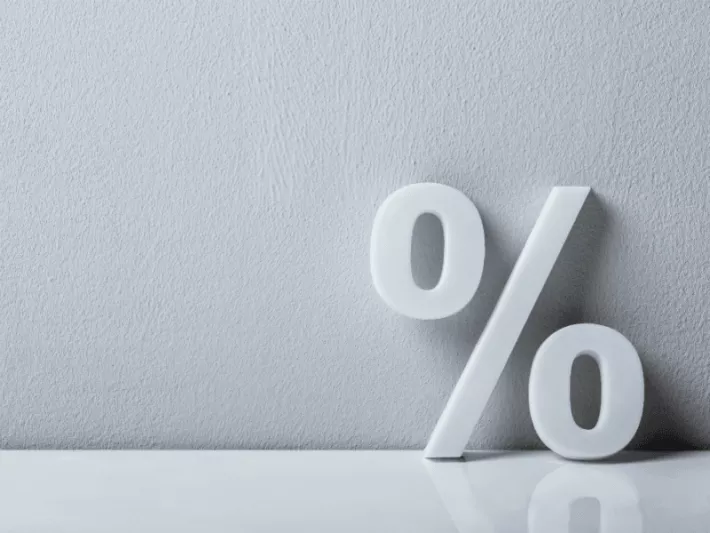
How to calculate percentages can be easier than you may realize. Keep reading for some simple tricks.
Long time math fans may remember our first foray into the world of percentages way back in the 12th and 13th episodes of the podcast. In those shows we learned what percentages are, how they’re related to fractions, how to use percentages to easily calculate tips at restaurants, and how to use percentages to easily calculate sales prices when shopping.
If you’re not sure how to perform any of those handy calculations, or if you’re just in need of a general percentage refresher, I highly recommend taking a look at those earlier shows and getting yourself up to speed. Why? Because once you’re caught up, you’ll be ready to step up and learn how to become a true percentage-calculating machine. Which is exactly what we’re going to turn you into today.
See Also: 3 Frequently Asked Questions About Percentages
Recap: What Are Percentages?
To make sure we’re all on the same page, let’s kick things off by taking a minute to recap a few key facts about percentages. Let’s start with the most important question: What are percentages? Perhaps the most illuminating thing to know is that the word “percent” is really just the phrase “per cent” squashed together. And since “cent” here means 100 (as in “century”), we see that the word “percent” just means “per 100.” In other words, 10% means “10 per 100,” which is the same as the fraction 10/100 or 1/10.
This turns out to be great news since it makes lots of percentages easy to calculate. In particular, it’s easy to calculate 10% of any number since that’s just 1/10 of the number. Why is that so helpful? Because it means that you can quickly calculate 10% of a number simply by moving its decimal point 1 position to the left.
But what about calculating something like 36% of 25? Or maybe 250% of 20? In these cases, our trick of using the power of 10% doesn’t help—so what can we do?
How to Quickly Calculate Percentages
One trick that will often help you quickly calculate these types of percentages is to use the fact that x percent of y is the same as y percent of x. Huh? I know that might sound kind of confusing, but it’s actually pretty simple. Taking our example from before, this rule says that 36% of 25 is the same as 25% of 36. How does that help us? Well, since 25% is the same as the fraction 1/4, we see that 25% of 36 must be 36/4 or 9. So 25% of 36 is equal to 9, and 36% of 25 must also be 9.
The beauty of this trick is that every time you’ve solved one problem, you’ve actually solved two! And that’s especially useful when one of the problems is much easier to solve than the other—as was the case here.
It’s helpful to take a minute to see why this seemingly magical trick works. As I mentioned before, 36% is equivalent to the fraction 36/100. Since we can write the fraction 1/100 as the decimal number 0.01, we see that the fraction 36/100 can also be written 0.01 x 36. That means that 36% of 25 must be equal to (0.01 x 36) x 25. Now here comes the cool part: The associative property of multiplication tells us that we can multiply several numbers in any order we’d like. Which means that (0.01 x 36) x 25 = (0.01 x 25) x 36. But 0.01 x 25 is the same thing as 25%, which means that this is equal to 25% of 36. So 36% of 25 is equal to 25% of 36. It ain’t magic, it’s math! Pretty cool, right?
How to Calculate Percentages > 100%
What about the second example I gave earlier: 250% of 20? According to our rule, 250% of 20 must be the same as 20% of 250. Since 20% is just 2 x 10%, and since we know that it’s easy to find 10% of any number by dividing it by 10, we see that 10% of 250 is 250/10 = 25, and therefore that 20% of 250 must be equal to 2 x 25 = 50. According to the handy dandy rule we’ve just proven to ourselves, the fact that 20% of 250 is equal to 50 means that 250% of 20 must be equal to 50 as well.
But wait a minute. What exactly does it mean that 250% of 20 is equal to 50? And, more broadly, what do percentages greater than 100 signify in the first place? Well, just as something like 36% is equivalent to the fraction 36/100, it’s also true that something like 250% is equivalent to the fraction 250/100. In other words, the meaning of “per-cent” hasn’t changed, so 250% still means 250 per 100. So, just as we found earlier, 250% of 20 is equal to 250/100 x 20 = 2.5 x 20 which is 50.
See Also: Halloween Math and More Percentage Questions
What Do Percentages > 100% Mean?
There’s a common misconception that it doesn’t make sense to talk about percentages that are greater than 100. After all, you can’t have more than a whole of anything, right? Wrong—of course you can! It’s perfectly reasonable to talk about 1.5 somethings (which is the same as 150% of that something), or 2 somethings (which is the same as 200% of that something), or any other number of somethings.
Just remember: Anything less than 100% of a number will always be a number that’s smaller than the original; anything greater than 100% of a number will always be a number that’s larger than the original.
Wrap Up
Okay, that’s all the math we have time for today. In the meantime, remember to become a fan of the Math Dude on Facebook where you’ll find lots of great math posted throughout the week. If you’re on Twitter, please follow me there, too. Finally, please send your math questions my way via Facebook, Twitter, or email at mathdude@quickanddirtytips.com.
Until next time, this is Jason Marshall with The Math Dude’s Quick and Dirty Tips to Make Math Easier. Thanks for reading, math fans!
Percent image from Shutterstock