



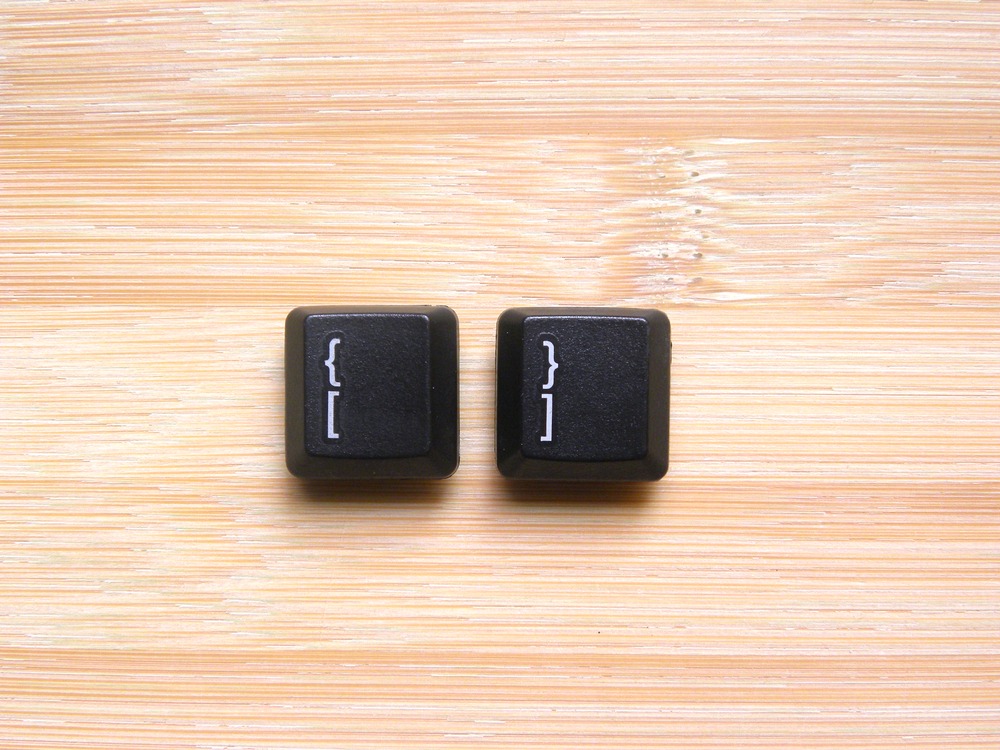
Today Bonnie Mills helps us talk about three punctuation marks: one you undoubtedly know how to use, another you possibly misuse, and yet another you’ve likely never used. If you’ve ever wondered when to favor parentheses over square brackets and when to stick in a pair of curly braces, read on.
Parentheses
You’re probably well versed in the basics of how to use those sideways eyebrow thingies, better known as parentheses, but the details can get tricky.
First, remember that a pair of them is called “parentheses,” but a single one is a “parenthesis.”
For now, let’s just say that parentheses mainly enclose information that isn’t vital to a sentence. You may want to review the episode in which we compared parentheses to dashes and commas because dashes and commas can separate things that aren’t vital to a sentence too, but the different ways of setting off information do have differences, but no matter what you put inside parentheses, one important thing to remember is that your sentence still has to make sense if you delete them and everything inside. And although you are allowed to put both partial sentences and complete sentences inside parentheses, you shouldn’t put more than a whole paragraph inside, according to Garner’s Modern English Usage. (1)
One thing people often wonder is how to use terminal punctuation marks with parentheses. If your sentence starts with an opening parenthesis, and what’s inside your parentheses is a complete sentence, then the terminal punctuation mark, such as a period, question mark, or exclamation point, goes inside the closing parenthesis: “(I knew he wouldn’t want to do that.)”
On the other hand, if what’s inside the parentheses is only a partial sentence, then you put the terminal punctuation outside instead, for example, if you wrote, “I moved to America when I was 10 (in 1980).”
For the most part, these two rules seem fairly easy to understand—complete sentence: terminal punctuation inside; partial sentence: terminal punctuation outside. But when you have a sentence that contains another complete sentence within parentheses, the punctuation can get confusing. Let’s say you want to add the complete sentence “I can’t believe it!” inside parentheses within another complete sentence. In this case, the exclamation point would go inside the closing parenthesis and then a period would go outside: “I ate the whole box of donuts (I can’t believe it!).”
That is the correct way to do it, but I often recommend simply losing the parentheses and making that sentence a complete sentence on its own that follows the first sentence. “I ate the whole box of donuts. I can’t believe it!” It’s always good to make sure you have a reason for putting something in parentheses.
Square brackets
Now it’s time to introduce our potentially misused friends: square brackets. These brackets, which are one long line short of a standing-up rectangle, appear on the keyboard to the right of the letter P. They are less common than their parenthetical cousins, although you do sometimes see both punctuation marks within the same sentence.
The Associated Press never uses brackets because their system can’t transmit them, so if you’re a newspaper writer, you’re free from the rules of this section.
For everyone else, one time to use brackets is when you want to put parentheses within parentheses. Since two parentheses in a row would be confusing, you bookend your parentheses with brackets. So, the order is opening parenthesis, opening bracket, closing bracket, closing parenthesis. For example, you would write “They are getting married (they love each other [of course!]).” That definitely looks clunky, but you could occasionally have a stylistic reason for wanting to do it that way. For example, maybe you’re writing dialogue for a scatterbrained character in a novel.
Square brackets are also a good way for editors to include comments in a document. (2) The square brackets make comments stand out since they’re so rarely used for other things.
A related way to use brackets is if you need to add a comment to clarify something in a quotation.
For example, if you are in a scholarly field, you may find yourself writing a paper and needing to directly quote an expert. But you may also need to clarify what the expert said, and this is where it gets tricky. Some writers will replace a section of a quotation with text in brackets to make it more clear, but some professionals suggest that it’s better to add a clarification instead of replacing text. For example, let’s say you have a quotation that reads, “This enterprising paleontologist discovered a new species of plant eater,” and you need to tell your readers who the enterprising paleontologist actually is. You could change it to “[Margo Figueroa] discovered a new species of plant eater.” but it would be better to add the name in brackets after the description, writing instead, “This enterprising paleontologist [Margo Figueroa] discovered a new species of plant eater.” (2, 3)
Note also that you shouldn’t use parentheses around the name you add, even though you might be tempted, because it would seem—incorrectly—like an aside that appeared in the original text because it’s in a quotation.
You may have also seen a quotation where just the first capital letter of the first word is in brackets. That pops up when a writer is quoting someone, but starts in the middle of a sentence, so the exact quotation doesn’t include a capital letter. This level of precision isn’t usually necessary according to both Garner’s Modern English Usage and the Chicago Manual of Style, but if your work requires you to be “rigorously accurate,” as Garner’s puts it, you can put that first capital letter in brackets to show that the way you have written it isn’t exactly as it was in the original. For example, if the quoted word is “it,” with a lowercase I, and a rigorously accurate scholar wanted the word “it” to start a sentence, it would be written bracket-uppercase I-bracket-lowercase T: “[I]t.”
You can also use brackets to note when something is missing in a text. For example, if you’re quoting from an old handwritten document, and a word is worn away, you can write “illegible” in brackets in place of that word. (4)
Note though that this is different from using an ellipsis—those three dots we talked about a couple of months ago—which you use when you are deleting words from a direct quotation. The ellipsis shows that you’ve made an editorial decision to omit text, whereas something like an “illegible” comment in brackets shows that something wasn’t able to be included.
The last place you are likely to encounter square brackets is around the Latin word “sic,” which means “thus.” You use it—in italics—when you’re quoting someone who has made an error, such as a spelling mistake. You should use bracket-sic-bracket only when absolutely necessary to aid readers; (5) you don’t want to show off or seem pedantic by constantly pointing out others’ failings. In fact, the most recent edition of the AP Stylebook says never to use it. Instead, if you’re tempted, they say to paraphrase the quotation instead.
Braces
Our last foray into punctuation marks leads us to what are known as curly braces. To type one, press the shift key as you punch the bracket key, to the right of the letter P. I must say I have never used curly braces. In fact, although they look like punctuation marks, they really aren’t, (6) at least not in the way you can type them yourself.
They’re on your keyboard because they have specialized uses in mathematics and science. For example, they are used to enclose the third level of nested equations when parentheses and brackets have already been used for the first two levels. (7)
Big curly braces that span multiple lines are sometimes used to enclose groups of words that belong together (8) or triplet lines in poetry, but your keyboard doesn’t have those big curly braces that span multiple lines.
Summary
Today you’ve learned how to use various curved, square, and curly squiggles within your sentences. Be sure to keep them straight!
References
- 1. Garner, B. “Parentheses.” Garner’s Modern English Usage, 4th edition, Oxford University Press. 2016. p. 752.
- 2. Garner, B. “Square Brackets.” Garner’s Modern English Usage, 4th edition, Oxford University Press. 2016. p. 754.
- 3. Walsh, B. Lapsing into a Comma, Lincolnwood (Chicago): Contemporary Books. 2000. pp. 57-8.
- 4. “Missing or illegible words.” The Chicago Manual of Style, 17th edition, University of Chicago Press. 2017. 13:59. (accessed February 16, 2022).
- 5. Garner, B. “Sic.” Garner’s Modern English Usage, 4th edition, Oxford University Press. 2016. p. 828.
- 6. De Vinne, T. L. 1904. The Practice of Typography, 2nd edition, New York: The Century Co.
- 7. Villamayor, et al. 2003. Using Math in This Millennium 6, Manila: Rex Bookstore.
- 8. Shaw. H. 1993. Punctuate It Right, 2nd edition. HarperPaperbacks.
Bracket image courtesy of Shutterstock.