5 Quick Facts About NASA’s Juno Mission to Jupiter

What is so risky about Juno’s special maneuver? How close will the spacecraft get to the gas giant, and what does it hope to learn? Here are five quick facts summarizing the excitement around the recent Juno mission to Jupiter.

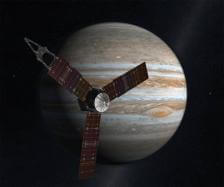
Late on the night of July 4th, NASA team members spent a suspenseful 35 minutes watching as the spacecraft Juno attempted to enter the region around the gas giant planet Jupiter, using a risky maneuver known as an orbital insertion. The main goal of this mission is to learn more about the origin and evolution of Jupiter, which will ultimately improve our understanding of how our entire solar system came to be.
What is so risky about Juno’s orbital insertion maneuver? How close will the spacecraft get to the gas giant, and what does it hope to learn? Here are five quick facts summarizing the excitement around the Juno mission.
1. Juno will get closer to Jupiter than any previous spacecraft ever has
Jupiter is surrounded by an intense band of highly energetic charged particles known as a “radiation belt.” A planet’s magnetic field offers protection against such particles, but will also cause them to be trapped along the magnetic field lines in toroid, or donut-shaped, belts.
Mercury, Jupiter, Saturn, Uranus, and even Earth are known to have radiation belts. Venus and Mars, however, do not have significant magnetic fields, and so do not have the ability to trap particles. Jupiter has the strongest magnetic field in the solar system, at nearly 20,000 times stronger than that of the Earth.
To protect them from the planet’s intense radiation field, the instruments on board the Juno spacecraft are housed inside a 400-pound titanium vault. The probe will circle the planet 37 times over 20 months, traveling between Jupiter and its radiation belt. That’s about 16 days per orbit, compared to the 90 minutes it takes to traverse a low Earth orbit.
NASA’s Galileo spacecraft orbited the gas giant at a distance larger than 200,000 miles and, despite being heavily shielded, was still damaged by the radiation field. Cassini, NASA’s Saturn-focused mission, only made it to almost 6 million miles away. Juno, however, will come as close as 2,600 miles from the tops of Jupiter’s clouds.
2. NASA only has one shot to get Juno into orbit
Upon its approach to Jupiter, Juno will be the fastest human-made object ever recorded, traveling at 40 miles per second (that’s 144,000 miles per hour.) The probe will thus have to slow down significantly to enter into orbit around Jupiter. To do so, Juno will burn its engines for a suspenseful 35 minutes. If the maneuver is not done precisely right – the right timing, the right amount of deceleration, the right positioning – the $1.1 billion spacecraft will miss its entry point and pass by Jupiter, drifting off into space.
3. Data collected by Juno can help settle a debate about how planets, including Earth, are formed
Despite our ability to send probes to view our own planetary backyard close up, and now our ability to detect planets around other stars, there are still major unanswered questions about how such solar systems form.
Formation theories always begin with a collapsing cloud of gas and dust. Most of that material goes into forming a star, like our Sun, and the remainder can be used as building blocks for planets. However, it’s not clear exactly how this is done: do planetary cores form first, and then accumulate their outer layers of gas just through gravitational attraction? Or do particularly large instabilities in that collapsing gas cloud collapse separately to form planets?
Learning more about the make up of Jupiter’s core can help differentiate between these two scenarios, and is thus one of the main goals of the Juno mission. Juno will measure both the gravitational and magnetic fields surrounding the gas giant planet to reveal both the interior structure and mass of the central core.
 4. Juno will attempt to measure the water in Jupiter’s atmosphere
 4. Juno will attempt to measure the water in Jupiter’s atmosphere
Along with gravitational and magnetic field measurements, Juno will also take an in depth look at the atmosphere of Jupiter. Those who have seen pictures of the planet can often recognize it by the large, colorful bands that cover its surface. These bands are created by strong winds that travel more than 400 miles per hour through the upper atmosphere. How deep these features penetrate the surface, however, is completely unknown.
Because Juno will be able to travel so closely to the planet, the probe will determine the composition, structure, and motions of the atmosphere below the cloud tops for the first time. In particular, the spacecraft will measure the water and ammonia in the gas giant’s atmosphere.
Due to its size and mass, Jupiter is more robust to the violent beginnings of our solar system, and thus still maintains clear imprints of that history. Some formation theories predict that as Jupiter formed, so did icy planetesimals, or small proto-planets. The water and carbon compounds that formed the fundamental building blocks for life here on Earth may have been carried here via these icy planetesimals, and so understanding their origins is essential for understanding our own.
5. Juno will be the first spacecraft to observe the poles of Jupiter
An incredible amount of energy in the form of charged particles is constantly bombarding the polar regions of Jupiter due to the planet’s strong magnetic field. The hydrogen gas below the planet’s surface is under such great pressures that it forms an electrically conducting fluid known as “metallic hydrogen,” which is believed to be the source of that magnetic field.
Juno will use an ultraviolet camera to observe the resulting auroras, the strongest in the solar system, as well as sample the charged particles to better understand these extreme conditions.
Jupiter is massive – more than twice the mass of all the other planets combined – and more than 11 times the size of the Earth, so its formation history has clearly shaped the orbits of its neighbors. Some formation theories suggest that Jupiter forced Neptune and Uranus outward to their more distant orbits, while also flinging debris inward toward the Earth. Now that the solar system has settled, some planetary scientists predict that Jupiter acts as a shield, protecting us from potentially deadly asteroid impacts.
Thus, understanding Jupiter’s history helps us understand our own history. Unlocking the secrets of the origins of our solar system contained within the core and atmosphere of Jupiter brings us one step closer to understanding how we came to be, as well.
 You can follow along with Juno’s journey and read more about the science goals of the mission on the mission website. NASA even has an app that you can use to track Juno’s progress and get up-to-date information on the location of the probe.
Until next time, this is Sabrina Stierwalt with Ask Science’s Quick and Dirty Tips for helping you make sense of science. You can become a fan of Ask Science on Facebook or follow me on Twitter, where I’m @QDTeinstein. If you have a question that you’d like to see on a future episode, send me an email at everydayeinstein@quickanddirtytips.com.
Images courtesy of NASA/JPL-Caltech and Shutterstock.